Study tours draw students to museums
From:China DailyAuthor: 2025-01-16 09:54
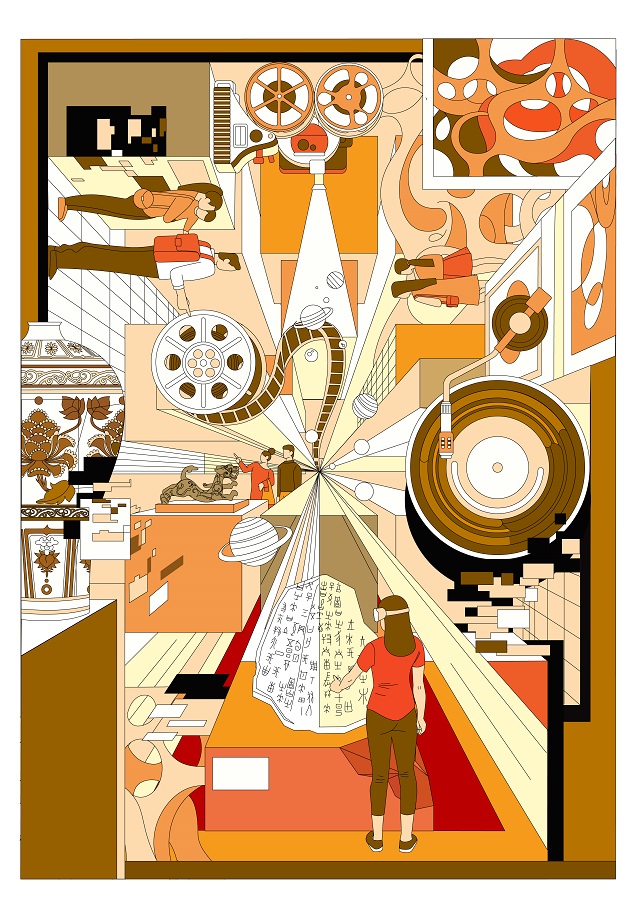
(Shi Yu/China Daily)
Determined to find a study tour slot for her 11-year-old daughter at the National Museum of China in Beijing, Liu Zhengqun had been monitoring the programs offered by the country's leading museum since December. Last week, she secured a place in a two-hour study tour for her daughter, who had been waiting for this chance since last summer.
"My daughter asked me to take her to the museum during the summer vacation," said Liu, from Wuhan in Hubei province. However, the rush for the museum was so huge at the time that they failed to secure any tickets.
Liu was initially surprised by her daughter's must-do list for her first visit to Beijing. The child did not want to see the Great Wall or eat Peking Duck like most tourists. She wanted to see the national treasures and learn the stories behind the precious artifacts.
"The school has been encouraging students to go to museums and explore more outside of classes. Study tours in museums are really popular now," said Liu.
At a meeting held by the National Cultural Heritage Administration on Jan 8, it was announced that museums around the country had received more than 1.4 billion visitors in 2024. With people's fascination for museums growing, the past year has seen the educational function of museums being significantly enhanced and study tours becoming increasingly popular.
Zhou Jingcheng, director of the public education department at the National Museum of China, said the popularity of museum study tours has increased rapidly over the past two years, leading to a boom.
Last year, the National Museum of China provided education services to middle schools in Beijing as many as 1,326 times, serving more than 38,000 students. At the same time, a large number of people from outside Beijing also came to the National Museum to participate in study programs.
"These study tours are designed to be very interesting and interactive and have been received warmly by children and teenagers. Many return to participate in different tours," said Zhou.
The museum's study tours are generally divided into two categories: one focuses on showcasing China's long history, with each program concentrating on a different dynasty, mainly targeting middle school students; the other highlights China's unique cultural symbols, covering four areas: art, science, intangible cultural heritage, and music, dance, and clothes.
A regular study tour, often held on weekends, usually lasts two hours and includes a visit to an exhibition, a classroom session, and a hands-on activity, such as making a cup of tea after learning about China's tea culture.
In an effort to diversify its offerings, the museum introduced six outdoor tours to archaeological sites in other provinces last year, including Hebei, Shanxi, and Shaanxi. These trips, lasting three to five days, allow participants to experience the role of archaeologists firsthand. The outdoor tours, which are open to both children and adults, have proven to be extremely popular.
The museum's four-day winter camps, set to open in mid-January, sold out within two days at the end of December.
"The popularity of museum study tours can be partly attributed to people's increasing demand for high-quality spiritual products. Museums' efforts to provide interesting and various programs are also important," said Zhou, who is also director of the special committee on public education of the Chinese Museum Association.
Diversified tours
The popular Jinsha Site Museum in Chengdu, Northwestern China's Sichuan province, has been conducting study tours since 2014. The spacious museum includes several exhibition halls, a relics hall where visitors can see the archaeological site itself, and a garden area that recreates the natural environment of ancient times.
In the past two years, the museum has organized about 140 study tours. These tours offer hands-on experiences such as working as an archaeologist, repairing relics, making golden wares, and learning about ancient architecture.
According to He Lili, director of the museum's public education department, the interest in these programs has grown significantly. She has worked at the museum for a decade and recalls that 10 years ago, the Junior Interpreter study program received only a few dozen applications each year. Last year, the museum received more than 1,000 applications.
The museum is dedicated to promoting the culture of the more than 3000-year-old Shu civilization. Many of the tours are specifically designed to focus on this ancient civilization.
For instance, the museum offered a four-day tour that allowed children to visit various locations to learn about the Shu civilization from different perspectives, including archaeological sites and other museums. During the tour, participants even had the unique opportunity to spend a night at the museum, sleeping in tents set up in the exhibition halls.
Last year, to make the tours more appealing, the museum partnered with a Shu embroidery factory and a lacquerware factory. Participants were invited to experience these traditional crafts firsthand after learning about related relics in the exhibition halls.
"Museums have become an important destination for family education. On Children's Day, long lines form at the entrance from early morning, with many parents bringing their children, hoping to take part in our study tour. This did not happen previously," said He.
Open to the public since 2019, the Confucius Museum in Qufu, Shandong province, capitalized on the trend of study tours in 2023 by launching several attractive educational products.
The museum is dedicated to the life, teachings, and legacy of Confucius, the renowned Chinese philosopher and educator. It showcases a vast collection of artifacts, manuscripts, and historical relics related to Confucius and Confucianism. Its tours are designed to enable visitors to explore details of Confucius' life, as well as his philosophical ideas.
One popular program centers on its large collection of traditional clothes from the Ming and Qing dynasties (1368-1911), allowing participants to make replicas of antique robes. Another standout program focuses on food cooked by the Confucius family, where participants can prepare the same cakes as those made by the ancient people.
Cheng Liqi, director of the Confucius Museum's public education department, mentioned that during the National Day holiday in October, they conducted three study tours per day, catering to 60 families. Despite their best efforts, they could not meet the significant demand from families visiting the museum from other cities. In November, students from several middle schools in Beijing and Shanghai visited the museum to participate in the tours.
Cheng's team also received invitations from schools in Fujian, Guangdong, and the Inner Mongolia autonomous region to conduct in-classroom study tours. For these, the museum provides multimedia materials and creative products related to hands-on activities.
"They want to learn something during their visit while also having fun and relaxing. This is what people expect from study tours. And museums have made great efforts to meet these demands in the past two years," Cheng said.
She added that she could see a rapid increase in the number of students visiting museums, a trend supported by policies issued by government bodies at all levels.
Policy and guidance
Early in 2016, the Ministry of Education and 11 other ministries jointly issued guidance on promoting study tours for primary and secondary school students. Subsequently, lists of study tour destinations were circulated widely by government bodies. This form of study, characterized by "going out," is seen as an innovative way to connect school education with extracurricular education.
The National Cultural Heritage Administration has also launched several supporting policies to encourage museums to collaborate with schools to promote traditional culture in an engaging manner. The most recent initiative, implemented in September, provides guidance on supporting archaeological sites to carry out study activities and calls for organizing more archaeology-themed tours.
Additionally, governments of various cities have implemented concrete policies to support this initiative.
Liu Kun, head of the public education department at Shenzhen Museum in Shenzhen, Guangdong province, mentioned that the department has been receiving lots of calls from schools every day since the local government announced a policy requiring students to spend half a day each week at cultural institutions in October.
"We have a very limited number of workers to deal with such a big demand from schools," said Liu. In fact, the museum only has three employees focusing on study tours and programs.
The museum collaborates with schools to co-produce guidebooks for each exhibition, to help teachers and students learn from the book while visiting. However, it's still not enough to meet the massive demand.
During the summer vacation, the museum remained open for over 40 consecutive days, with peak daily attendance reaching approximately 25,000 visitors. As a result, it had to reduce the number of study tours due to a lack of staff.
"We really hope to engage the education system and some qualified social institutions to offer high-quality study tours with us," Liu said.
Museum study tours can be categorized into three types: school-led, museum-led, and institution-led. Institution-led programs are developed independently by organizations such as travel agencies, cultural companies, or study tour institutions. These programs currently dominate the market in terms of quantity, variety of themes, and number of participants, said Zheng Yi, director of the Department of Cultural Heritage and Museology at Fudan University.
School-led and museum-led study tours are relatively fewer in number, and thus cannot fully meet the market demand. Consequently, institution-led museum study programs have gradually become a popular choice among consumers, said Zheng.
There are controversies surrounding museum study tours led by third-party institutions. For instance, the explanations given during these tours are often not accurate and can mislead students. The high demand for these study tours also makes it difficult for other visitors to secure reservations. Also, groups of students crowding around a piece of artifact can disrupt the viewing experience of others.
"To ensure the healthy development of study tours, scientific guidance is necessary. It's better to manage and guide these activities rather than block them," suggested Zheng.
Zhou, an expert from the Chinese Museum Association, said the healthy development of museum study tours will happen over time. The quick boom has led to problems. The National Museum of China where he works is working on a guidance to standardize study tour services in museums.
In the future, he said that technology could help meet the increasing demand.
Edit:董麗娜
The copyright of the article and the picture belongs to the original author. If there is any infringement, please contact to delete it